



Do you want to reach financial independence and have the option to retire early?
Today, I’m excited to share an interview with Cody Berman, an entrepreneur, real estate investor, and personal finance expert who reached financial independence at just 25 years old.
Cody’s story is especially interesting because he didn’t follow a traditional path or wait decades to build wealth. Instead, he focused on increasing his income, keeping his expenses low, and investing consistently. In just a few years, he grew his net worth to over $1,000,000, built multiple income streams, and created a life where work is completely optional.
Since then, Cody has helped thousands of people learn how to build wealth and gain more control over their time and money. He also recently wrote a new book, Retire by 30: How to Build Wealth, Gain Freedom, and Live Life on Your Own Terms, which shares a step-by-step plan for reaching financial independence faster than most people think is possible.
I recently read Cody’s book and I ended up flying through many chapters in just one day because I honestly enjoyed it so much. The book felt encouraging and real at the same time, and it explained financial independence in a way that felt doable, not overwhelming. Because I enjoyed the book so much, I asked Cody if he would do an interview here on Making Sense of Cents (he said yes!).
In this interview, Cody shares exactly how he did it, including how he increased his income so quickly, how he kept his expenses low, and how he built both stock market and real estate investments.
He also answers questions like:
- How can you calculate your financial independence number?
- What are the best ways to increase your income?
- What are realistic side hustles you can start today?
- How do you invest if you want to retire early?
- What does life actually look like after reaching financial independence?
And more.
How I Reached Financial Independence at 25 With a $1,000,000 Net Worth
If you’ve ever wondered if early retirement is possible for you, or you just want more flexibility and freedom in your life, then this interview is packed with helpful tips and real-life advice.
Note: Cody might sound familiar because he’s been featured here on Making Sense of Cents before, such as in the article How I Made $6,161 in Just 4 Months With a New Etsy Printables Shop. He’s always a wealth of knowledge!
1. Tell us your story! Who are you, and how did you reach financial independence so quickly at such a young age?
Hey! I’m Cody Berman. Some of you might have come across me if you’ve ever looked into selling digital products, but I’m also really passionate about personal finance.
I first learned about financial independence after reading The 4-Hour Workweek by Tim Ferriss. That quickly sent me down the rabbit hole. I started reading blogs like Mr. Money Mustache and The Mad Fientist, and listening to podcasts like ChooseFI and BiggerPockets Money. Within no time, I was completely obsessed with the idea of achieving financial independence.
Like a lot of people, I started on the “traditional” path. I got a finance job paying $80k straight out of college and thought I was doing everything right. But between the two-hour commutes, eight-plus hours in a cubicle each day, and being surrounded by coworkers and bosses who didn’t seem happy, I quickly realized this couldn’t be what life was all about.
So I started plotting my escape.
On the train ride to work, on my lunch break, on the way home, and at night, I was building side hustles and testing business ideas. After seven months, I had saved $35,000 from my job, and my side hustles were bringing in about $1,200 per month. That’s when I decided to take the leap into full-time entrepreneurship.
I remember thinking, “If I can make $1,200 a month while working full time, what could I do if I went all in?”
The next three years were all about scaling those side hustles, keeping my expenses low, and investing the difference. By the end of year three, I had gone from almost nothing to over $500,000 invested in the stock market, 11 rental properties, and a thriving digital products business.
That three-year stretch was intense, but it ended up being one of the best decisions I’ve ever made.
2. What has your income, savings rate, and net worth looked like over those years?
During the three years it took me to reach financial independence, my income climbed quickly, but my expenses stayed almost exactly the same.
In year one, I made $96,000 and spent $24,000, which gave me a 75% savings rate. By the end of the year, my net worth was around $179,000.
In year two, I made $198,000 and still only spent $24,000, increasing my savings rate to 88%. My net worth grew to about $392,000.
In year three, I made $403,000 and kept my spending at $24,000 again, bringing my savings rate up to 94%. By the end of that year, my net worth had crossed $1,035,000.
Even though my income was growing fast, I didn’t inflate my lifestyle. Instead, I invested the difference into the stock market and real estate, which both performed well during that time.
I’ll break down the specific strategies I used to increase my income and keep my expenses low later in this article, but this is the key idea: the gap between what you earn and what you spend is everything.
If you can consistently widen that gap, financial freedom becomes a lot closer than you think.
3. A lot of people hear terms like FI, FIRE, and early retirement and feel confused. Can you explain what these mean in an easy-to-understand way?
Absolutely. Personal finance can seem confusing with all the different acronyms, but the concepts themselves are pretty straightforward.
FI stands for Financial Independence. This is the point where your investments and passive income streams fully cover your lifestyle. Once you reach FI, you no longer have to work for money.
FIRE stands for Financial Independence, Retire Early. Once you hit FI, you have a choice. You can keep working, or you can step away from work completely. That’s the “RE” part. Personally, I’ve reached FI, but I haven’t “FIRE’d” because I still enjoy working on the businesses and projects I’m building.
Early retirement is where a lot of people get confused. Most people think of retirement as an age, but it’s really a number. It comes down to a simple math equation. Once your investments can cover your expenses, you can retire. That could be at age 25, 47, or 53.
Early retirement just means you’re getting there faster than the traditional path of retiring at 65.
4. Do you think someone has to fully stop working in order to be financially independent, or can FI look different for different people?
Financial independence comes in many different forms.
Here are seven of the main ones:
- Mini-retirements are intentional breaks from work before traditional retirement age. Instead of saving all your freedom for the end of life, you take smaller breaks along the way to travel, rest, explore, or reset. They can be a great way to test what you actually want your post-FI life to look like.
- Coast FI means you’ve already invested enough that it will grow to support you later without adding another dollar. You still cover your current expenses with earned income, but you don’t need to aggressively save anymore. It’s a huge mental shift because the heavy lifting is already done.
- Barista FI is when your investments cover most, but not all, of your expenses. You work a part-time or lower-stress job to fill the gap, often for benefits like health insurance. It gives you flexibility without needing a full portfolio.
- Lean FI is the most barebones version of financial independence. Your investments cover a very minimal lifestyle, so you have freedom, but not much room for extra spending. It’s ideal if you value time over comfort and are okay with living simply.
- Cash Flow FI is when income-producing assets like real estate or businesses generate enough monthly cash flow to cover your expenses. Instead of selling investments, your income shows up consistently each month. A lot of people like this approach because it feels more tangible and predictable.
- Traditional FI is what most people think of when they hear financial independence. Your investments can fully cover your current lifestyle. This typically happens when you have 25x your annual expenses invested. At this point, work is completely optional.
- Fat FI is financial independence with a higher spending level. Your investments support a more comfortable lifestyle, with extra margin built in. It usually takes longer to reach, but it gives you the most flexibility and security.
There’s no “right” way to do it. Your version of financial independence depends entirely on you and your preferences.
Recommended reading: 18 Passive Income Ideas To Earn $1,000+ Each Month

5. What does your day-to-day life actually look like now that you’re financially independent?
Even though I’m financially independent, that doesn’t mean I just sit around and sip margaritas on the beach. I still enjoy working on projects that excite me.
For about eight to nine months out of the year, this is what an ideal day looks like for my wife and me:
7:00 AM–9:30 AM: Gym and/or something active like running or walking
9:30 AM–10:00 AM: Morning smoothie and practicing Spanish
10:00 AM–12:30 PM: Work on our businesses or other projects
12:30 PM–1:00 PM: Lunch
1:00 PM–2:00 PM: Afternoon walk
2:00 PM–6:00 PM: More work, projects, or business-related tasks
6:00 PM–6:15 PM: Quick workout before dinner
6:15 PM–7:00 PM: Cook and eat dinner together
7:00 PM–9:30 PM: Spend time with friends, plan trips, watch TV, talk, etc.
9:30 PM–10:00 PM: Read for a bit, then head to bed
For the other three to four months, we like to travel and spend less than an hour per day working.
You could say I like to work in “seasons.” Some months I’m fully focused and working hard on a project, like my recent book launch. Other months, I’m barely working at all.
The key for me is optionality.
Not having to work actually makes work more exciting and fulfilling. It allows me to focus on the projects I genuinely care about.
6. You kept your expenses under $2,000 per month. What did that actually look like in real life? What were you spending money on and how did you save money? How were your expenses so low? Are they still this low today?
It might sound crazy, but during the first three years of my financial independence journey, I kept my expenses under $2,000 per month. The key was optimizing the Big 3: housing, transportation, and food. Here’s how I approached each:
Housing: Instead of renting an apartment like many of our peers, my wife (then girlfriend) and I decided to house hack by buying a multifamily property. House hacking means you live in one unit and rent out the others. Each month, we made $500+ in rent after all expenses, including the mortgage, were paid. From the outside, our lives didn’t look much different. Our home was similar in size to others. But instead of paying for housing, we were getting paid.
Transportation: Even as my income increased each year, I kept driving the same paid-off truck. While others upgraded and took on $500+ monthly car payments, I only paid for gas and insurance. Again, nothing looked extreme from the outside. It was a solid, reliable car, just not brand new or flashy.
Food: We still went out to eat and grabbed drinks during this time, but we were more intentional. At restaurants, we might share an appetizer and entrée instead of ordering multiple of each. When we went out for drinks, we might have one or two instead of several. Frugality doesn’t mean deprivation. You can still enjoy life, you just do it with a bit more intention.
For the average American, these three categories make up about 67% of total spending. Optimizing them was the biggest reason I was able to keep my expenses so low during those years.
Today, I spend a lot more than $2,000 per month, but only on the things I truly value. We still house hack, and I still drive a paid-off car, but we spend more on travel, dining out, and experiences.
7. Your income grew really quickly. What were the biggest things you did to go from around $96K to over $400K?
During the three years when my income jumped from $96K to $198K to $403K, I was going all-in on entrepreneurship. My digital products business was taking off, I was buying rental properties, and I was building my personal finance brand.
The biggest shift was moving toward scalable side hustles instead of just trading time for money. Before that, I had done things like delivering UberEats, writing freelance articles, and editing podcasts. Those all required me to trade my time for money directly.
My income really started to accelerate when I focused on building and buying assets that could pay me over and over again. With digital products, I could create something once and sell it hundreds or thousands of times. With real estate, I bought a property once, and it generated rental income while appreciating in value. With my personal finance brand, I created content that continued to earn through affiliate commissions and product sales long after it was published.
That was a major shift from the “one-and-done” side hustles I’d done before. These scalable income streams allowed my earnings to compound over time.
Recommended reading: 17 Best Income Generating Assets That Make Passive Income
8. For someone who wants to make extra money, what are some realistic side hustles they could start today?
Digital products were what worked for me, and I’ve talked about them in depth in a previous interview, but there are hundreds of different side hustles you can choose from.
Instead of giving you a “here’s the best side hustle to try,” I think it’s more helpful to give you a framework for the four main types of side hustles, and then let you decide.
Trading Time for Money: These are the most straightforward side hustles. You get paid for the time and effort you put in, and your income stops when you stop working. They are great for quick cash and have a low barrier to entry, but they do not scale easily. Examples include driving for Uber or DoorDash, freelance writing, or working as a virtual assistant.
Scalable Side Hustles: These side hustles focus on building or buying assets that can generate income repeatedly with little additional effort. They usually require upfront time, money, or both, but can pay you long after the initial work is done. This is where income starts to compound. Examples include selling digital products, investing in rental real estate, or building income through affiliate marketing.
Sharing Economy: With sharing economy side hustles, you make money by renting out assets you already own. This allows you to generate income from things that would otherwise sit unused. It’s a simple way to get started without creating something new from scratch. Examples include renting out a spare room on Airbnb, listing your car on Turo, or renting out storage space.
Hybrid Hustles: These combine elements of trading time for money with scalable or asset-based income. You might start by offering a service, then turn that experience into something more leveraged over time. This creates a path from active income to more passive income. Examples include a freelance designer who sells templates, a coach who creates an online course, or a photographer who sells presets or stock photos.
There’s no “best” side hustle. That’s like asking what the “best” food is. It completely depends on you and your preferences. Try a few and see what sticks.
9. How can someone figure out how much money they actually need to retire?
First, you need to calculate how much you’re spending each month. Look through your bank and credit card statements and come up with a monthly average. Once you know what you’re spending, you can start building a plan for financial independence.
There are two main strategies to get there:
1. The Nest Egg Method – This is the traditional path to financial independence. You build up a large portfolio of investments, then withdraw from it each year to cover your expenses. A common rule of thumb is the “25x rule,” which says you need about 25 times your annual expenses invested.
For example, if you spend $50,000 per year, you would need about $1.25 million invested to reach financial independence. From there, you draw from your portfolio to fund your lifestyle, while your investments continue to grow in the background.
2. The Cash Flow Method – This method focuses on building income streams that consistently produce enough to cover your expenses. Instead of drawing down your investments, you live off the income your assets generate each month.
Using that same $50,000 per year example, your goal would be to build income streams that produce about $4,167 per month. This could come from rental properties, businesses, digital products, or other assets that generate ongoing income. The key difference is that your assets are designed to keep producing income without needing to be sold.
Personally, I used a combination of both to reach financial independence. But it all started with knowing my numbers. Once you understand how much you’re spending each month, you’ll have a much clearer picture of what it will take to hit your financial independence number.
10. Do you think health insurance is one of the biggest concerns for people who want to retire early? How should they plan for it? What do you do for health insurance?
I can only speak from my own experience, but health insurance ended up being far less of a concern than many people made it out to be. That said, it can vary widely depending on your location, family size, and specific health needs.
When I left my job in 2019 to go all-in on entrepreneurship, I found a high-deductible plan through the Massachusetts Health Connector for $274 per month as an individual (this was before I was married). The cost gradually increased over time, but nothing dramatic. As of 2026, my wife and I are on a shared plan and pay $714 per month total for health and dental.
The key takeaway is that health insurance is not some unknown, unsolvable problem. You can go on Healthcare.gov or your state’s health exchange right now, plug in your information, and get real quotes in a matter of minutes. That gives you a much clearer picture of what to expect.
Like any other expense, it’s just a number. And once you know that number, you can build it into your financial independence plan, whether that means increasing your nest egg target or making sure your cash flow covers it.
11. For someone reading this who has no money saved and feels behind, what would you tell them to do first?
The most important factor in achieving financial independence is the gap between your income and your expenses. That gap is what allows you to save, invest, and ultimately build wealth.
If you’re a high earner but still feel stuck living paycheck to paycheck, it’s worth taking a hard look at your spending. Try to focus on the Big 3: housing, transportation, and food. These are your largest expenses, and even small changes here can have a massive impact, even if they’re a bit uncomfortable at first. Cutting out Starbucks and Netflix can help, but the big expenses are the ones that really move the needle.
On the flip side, if you feel like you’ve already optimized your expenses and there’s not much left to cut, then the focus shifts to increasing your income. That could mean starting a side hustle, building a business, negotiating a raise, switching companies, or even changing industries altogether. Even a small boost in income can go a long way.
Once you create a gap between what you earn and what you spend, that’s when things really start to change. You can begin investing consistently, and over time, compound interest starts to do the heavy lifting. That’s when your money begins working for you, instead of the other way around.

12. What is your investing strategy, and how simple can someone keep it?
During my financial independence journey, about 95% of my money was invested in two places: the stock market and real estate.
On the stock market side, almost all of my investments went into total stock market index funds. This simply means I’m investing in the market as a whole instead of trying to pick individual winners. It’s a simple strategy, but it works. In fact, over 90% of professional investors fail to beat the market over the long term, which is why I stick with index funds.
I also make the process as easy as possible by automating everything. I max out my retirement accounts and have money automatically invested from my bank account each month. That way, I never have to think about it.
On the real estate side, I focused on buying long-term rental properties in markets where the numbers made sense. One rule of thumb I used was the 1% rule, which says a property should generate at least 1% of its purchase price in monthly rent. For example, a $300,000 property should bring in around $3,000 per month in rent.
I couldn’t find deals like that in my immediate area, so I expanded my search and found a market about an hour away where the numbers worked much better. That flexibility made a big difference.
Investing doesn’t have to be complicated, despite what a lot of “experts” make it seem. Pick a strategy that makes sense to you, set up the right accounts, and put your investments on autopilot.
13. Are there any budgeting tools, calculators, or apps that you recommend for someone who wants to retire early or reach financial independence?
I’m actually pretty simple when it comes to tools, and that’s intentional.
You don’t need a fancy app or complex system to reach financial independence. It comes down to understanding your income, your expenses, and the gap between the two.
That said, there are a few tools that can help, especially when you’re just getting started.
For budgeting, apps like YNAB or Monarch can make it easier to track your spending and see where your money is going each month. But you don’t need an app. A simple spreadsheet or even reviewing your bank and credit card statements can do the job just as well.
For tracking your overall net worth, I use Empower. It’s helpful to see all your accounts in one place and track your progress over time.
For calculators, search “compound interest calculator” and plug in some numbers. Prepare to have your mind blown. It’s a simple way to see how your money can grow and what it will take to reach your goals.
The best tool is the one you’ll actually use. Some people love apps, others prefer spreadsheets. There’s no right answer. What matters most is that you know your numbers and stay consistent.
14. Can you walk us through, step by step, how someone can start working toward early retirement and financial independence?
If you’re starting from scratch, I’d keep it simple and follow this basic order of operations:
1. Figure out how much you’re spending. Look through your bank and credit card statements and get a monthly average. This number matters because it tells you what lifestyle you’re trying to fund.
2. Calculate your financial independence number. A simple way to do this is to multiply your annual expenses by 25. If you spend $50,000 per year, your FI number is roughly $1.25 million, or $4,167 in monthly cash flow.
3. Optimize the Big 3: housing, transportation, and food. These are usually your largest expenses, so improving them can have a much bigger impact than cutting out small things here and there. If your Big 3 are different, then focus on those instead.
4. Increase your income. Once your biggest expenses are under control, growing your income can speed everything up. That might mean negotiating a raise, switching companies, changing industries, starting a side hustle, or building a business.
5. Build an emergency fund and pay off high-interest debt. You don’t need to have everything perfect before investing, but you do want a solid foundation so one unexpected expense doesn’t knock you off track.
6. Start investing consistently. For most people, that means using tax-advantaged accounts like a 401(k), IRA, or HSA if available, then investing in low-cost index funds. The key is to make it automatic so you don’t have to rely on motivation.
Finally, keep repeating the process. Track your numbers, increase the gap between your income and expenses, and invest the difference. That gap is what gets you to financial independence. Done correctly, and retirement will come a lot faster than you thought possible.
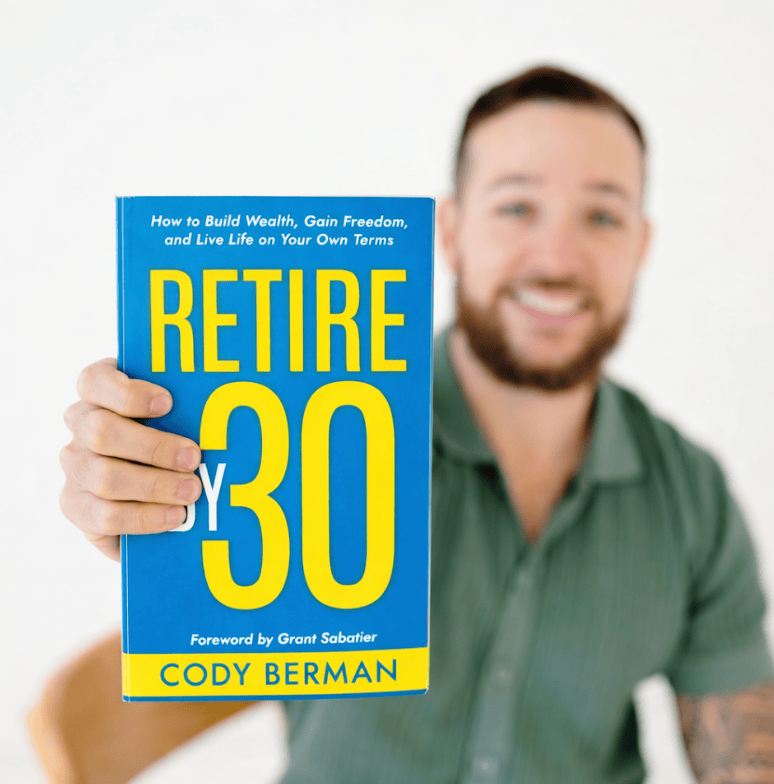
15. You recently wrote a new book called Retire By 30. Can you tell us about the book, who it’s for, and what someone will learn from reading it?
Retire By 30 is a simple, step-by-step guide to achieving financial independence without overcomplicating things. It’s the book I wish I had when I first started my own journey.
And despite the title, it’s definitely not just for people under 30. Honestly, it probably should have been called Reach Financial Independence Really Fast and Then Do Whatever You Want, but that didn’t quite have the same ring to it. It’s really for anyone who wants to retire earlier than the traditional path, or simply have more freedom and control over their time.
It’s broken down into five sections:
- The Basics – where you’ll learn what financial independence is, why the gap between your income and expenses matters, and how to calculate your retirement number.
- Expenses – where you’ll learn how to track your spending, manage debt, optimize the Big 3, and find 20+ ways to save more each month.
- Income – where you’ll learn how to increase your income through side hustles, maximize your day job, and network.
- Investing – where you’ll learn the basics of investing, including the stock market, real estate, alternative investments, and how to think about taxes across all of them.
- Early Retirement – where you’ll learn how to know when you can retire, different withdrawal strategies, and what life might actually look like once you get there.
I like to think of this book as a menu of options. It’s not a “you have to do this one thing” approach. It’s more like, here are a handful of different paths to financial independence. Pick the one that fits you best and run with it.
One thing that really makes Retire by 30 special is the 10+ case studies included throughout. These are real stories of people who reached financial independence in a decade or less. I share my own story, but I know not everyone will relate to it. That’s why I included people from different backgrounds, ages, and situations who all achieved financial independence in their own way.
After reading this book, you’ll have a clear understanding of where you are today, where you want to go, and the exact steps to get there. It’s designed to give you a simple, actionable plan so you can stop guessing and start making real progress toward financial independence.
Please click here to learn more about Retire by 30.
Note from Michelle at Making Sense of Cents: If you want to learn more about Cody and what he’s working on, you can visit his website at CodyDBerman.com.
What are your thoughts on early retirement? Do you think you’d ever want to reach financial independence?
Recommended reading:
Leave a Reply